The news today is
dominated by the headline ‘Treasury unveils £2.3bn for (flood) schemes to protect homes’.
In the light of recent flooding during late 2013/early 2014, this may seem a
prudent move by the government. As we have seen, climate science and
hydrological modelling suggests discharge and runoff (and thus flood regimes)
are going to change in the face of climate change. Reynard, et al. (2001) carried out hydrological
modelling based on climate change scenarios for the largest rivers in the UK
and predicted increases in the frequency and magnitude in the flooding of these
rivers. Interestingly, they find that land use is the largest influence (bar
climate) on the flood regimes; with an increase of forest in a catchment
flooding is less severe, but an increase in urban surfaces increases both the
frequency and magnitude of flooding. Clearly, land use is hugely important for
addressing future riverine flooding in the UK.
It may sound overly
cynical, but the announcement made by the UK Treasury today is little more than
political spin – the money is not new. The
Committee on Climate Change noted that these new schemes (in the
Thames Estuary, Oxford, Somerset) are perhaps missing the point, and that this
money should maybe go into managing existing defences. Hard engineering seems
to be the overriding strategy in the new schemes, and this likely reflects the
link between flood disasters and the demand for public policy (Johnson, et al. 2005). After the floods last
winter, the government wants to appear strong on the issue to the electorate –
what better way than to allocate money to good old fashion hard engineering? I
have no doubt these schemes will have been properly researched and will protect
some properties, but hard engineering is unlikely to be a long term answer to
changes in flood regimes.
As Reynard, et al. (2001) have suggested, land use
is a very important issue that we should be focusing on, in the form of
catchment management, and preventing overdevelopment on floodplains. Rivers
with wide, natural floodplains have a far greater natural capability to deal
with flooding. For example, take the River Wey (Surrey), a tributary of the
Thames that experienced some severe flooding last winter. The majority of the
river has ample natural floodplain, and such severe flooding did not occur in
these areas. However, there are a few pinchpoints where the floodplain has been
built on. Urban surfaces like concrete and tarmac have no ability to absorb
water, and thus flooding occurred heavily at these parts of the river – see the
picture of Guildford car park under many feet of water.
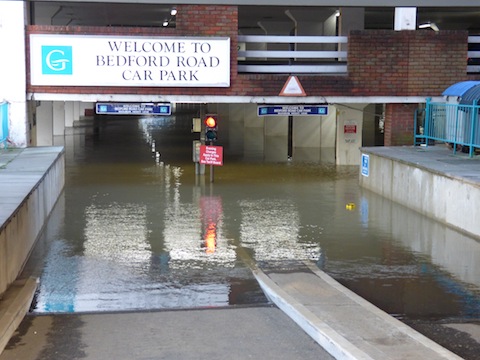 |
| Urbanised foodplain = underwater. |
Today’s new funding
is mostly a load of spin, and seems to very focused on making a political
point, and trying to win the hearts of the electorate before the next election.
Such flood projects have their place, but long term we need to focus on why we
have made property so susceptible to flooding, and why we are allowing changes
to the hydrological cycle to occur. If you don’t want to be flooded, don’t live
on a floodplain.



2 comments:
Hi Ali! It's interesting to see your take on the reallocation of funds in the Autumn Statement, and how hard engineering approaches have been adopted because they're seen as 'visible and obvious' security. It's clear from your post that, where possible, soft engineering methods and land management schemes are preferential due to their less severe implications for water stores and fluxes. I'm interested to know what sort of impacts hard engineering techniques are likely to have for ecosystem functioning, both fluvial and terrestrial. Thanks and keep up the good work!
Hi Marko, thanks for getting in touch, hopefully I can give you a little insight into your question. I tried to address it somewhat in the post I made yesterday, talking about how we are altering the natural channel so much with hard engineering, rivers can no longer buffer naturally to preserve ecosystems in the face of increased discharge. Hard engineering methods like dams can homogenise the flow of water (see Poff, et al. 2007), degrading aquatic habitats to which high flows can be key. For example, Xenopoulos, et al. (2005) show a decline in fish populations (perhaps relevant to your blog!) in catchments where discharge is reducing in the face of climate change and water abstraction/daming. Increasing discharge from hard engineering (e.g. diversion of water all into one channel) can also have negative effects on aquatic ecosystem function - organisms are more easily dispersed and water quality reduces with increased sediment, nitrate and pollutant fluxes (Nelson, et al. 2009).
Sorry that didn't directly address a fluvial/terrestrial divide but it is aquatic ecosystems in general that have been adressed in the literature. Hope this helps answer your questions!
My references if you'd like follow up:
Poff et al. (2007) http://www.pnas.org/content/104/14/5732.full
Xenopoulos, et al. (2005) http://onlinelibrary.wiley.com/doi/10.1111/j.1365-2486.2005.001008.x/abstract?deniedAccessCustomisedMessage=&userIsAuthenticated=false
Nelson, et al. (2009) http://onlinelibrary.wiley.com/doi/10.1111/j.1365-2664.2008.01599.x/full